


How to Build a Lending Software Platform in 2026: The Complete Guide
So, you've got the thought of building a lending software platform? Good move. The old way of doing things, paper forms, week-long approvals, a guy named Gary manually checking spreadsheets, that whole circus is dying fast. Well, you’re already behind even before launching if your platform can’t keep up, because borrowers today want answers in minutes, not days.
Why does 2026 matter? Lenders are under pressure to reduce costs while neobanks and embedded finance platforms keep raising the bar with instant approvals. If your platform still takes days to process loans, you're already behind.
This guide covers the essential systems, tech stack, compliance requirements, and realistic development costs. If you want a partner to walk through this with you, we'll get to that at the end. For now, here's the blueprint.
What Exactly Is a Lending Software Platform
Think of it as the engine room behind every loan that gets approved, funded, and paid back. A real lending platform isn't one piece of software, it's four separate systems that all have to work together without a single hiccup: origination, underwriting, disbursement, and servicing.
Skip any one of these, and you don't have a platform. You have a half-built app that's going to fall apart the second real money starts moving through it.
The Four Systems Every Platform Needs
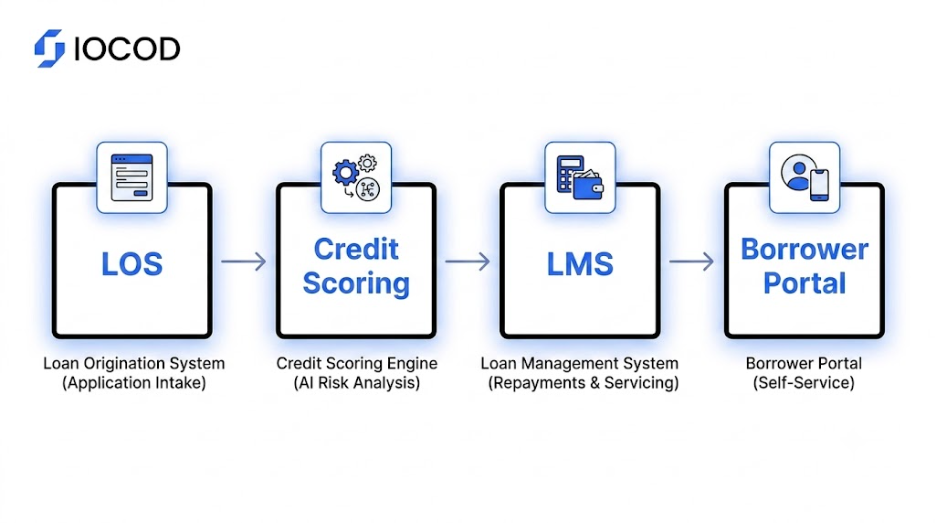
Here's the breakdown, plain and simple:
- Loan Origination System (LOS) - captures the application, runs eligibility checks, and routes the file.
- Credit Scoring Engine - pulls bureau data plus AI-based risk signals to make the call.
- Loan Management System (LMS) - handles repayment schedules, interest math, and collections.
- Borrower Portal - give your customers a place to check status, upload docs, and make payments without needing to call support every five minutes.
Each module should be able to scale and get maintained on its own, build it that way, never as a giant mess of code. That's the real difference between a platform that grows with you and one you'll be tearing apart in 18 months.
Who Actually Needs This
Every lender’s got a different problem, figure out who you are going to solve things for it, find your actual fit.
Fintech startups live and die at speed. The mission is simple, get an MVP live, prove the model works, and lock down your next funding round on a lean setup built around origination and credit scoring.
NBFCs and other alternative lenders aren't short on loan volume; that's not the problem. The real headache is still running through spreadsheets or outdated systems. What they need is automation that cuts the manual grind and gets more done with less effort.
Traditional banks play different games. Stricter compliance, legacy infrastructure, and slower decisions box them in. Their goal isn't a total rebuild; it's getting new lending software to work with what's already there.
Knowing which bucket you fall into shapes pretty much every move from here.
Step 1: Lock Down Your Lending Model Before Writing a Single Line of Code
This is the step everyone wants to skip, and it's exactly why so many lending platforms end up needing a full rebuild a year later.
Consumer loans, SME financing, and peer-to-peer lending each run on completely different workflows. SME lending usually needs collateral tracking baked in. Consumer lending leans hard into fast, automated credit scoring. Mixing these up at the planning stage is how you end up with a platform that does everything halfway.
Ask yourself these questions before moving forward:
- Who's actually borrowing, consumers, small businesses, or both?
- What is your average loan size and term length?
- Do you need collateral or guarantor tracking?
- Which states or countries are you lending in (this changes your compliance load massively)
- Are you originating loans yourself or partnering with a bank?
Lock these answers in early. Everything downstream, your architecture, your integrations, your compliance scope, gets built around these answers.
Step 2: Choose Your Deployment Model
Before architecture, decide how your platform will be hosted.
Cloud-native SaaS is the quick draw of the bunch, easy to spin up, easy to scale, and you're not stuck babysitting infrastructure.
On-premise still makes sense for banks juggling strict compliance or legacy systems, just know it comes with a heavier price tag and slower rollout.
Hybrid splits the difference, sensitive data stays in house while the heavy lifting like analytics runs in the cloud.
Most fintechs and NBFCs on the rise are going cloud native, while the bigger banks tend to stick with hybrid. Base your decision on your operational needs, not your pitch deck.
Stuck weighing cloud against on-premise against hybrid? That's a call worth making with someone who's actually shipped all three, not just read about them.
Step 3: Build the Architecture the Right Way (API First, Always)

Here's the one rule that separates platforms that scale from platforms that choke under pressure: never build a monolith.
A loan management system should never be one giant block of code. Going modular just saves you a headache down the line, easier to scale, easier to keep running smooth. The platforms doing it right these days are built on API first architecture, automation, AI that handles credit scoring, and compliance baked right in from the start, not duct taped on later.
Core Modules Your Architecture Needs
- Loan Origination - application intake, KYC, document verification.
- Credit Decisioning - bureau integrations plus scoring models.
- Loan Servicing - repayment schedules, interest calculations, adjustments.
- Collections - overdue tracking, restructuring workflows, automated alerts.
- Reporting and Analytics - compliance reports, portfolio dashboards.
Everything runs through one central integration layer, so data moves around without getting stuck or duplicated. And with a microservices setup, think Docker, Kubernetes, AWS or Azure, you can scale right alongside your loan volume without tearing down and rebuilding the whole platform.
Database Design for Lending Platforms
Most guides overlook one thing: your lending platform manages multiple types of data, and each needs different storage.
- Structured data: Loan records, payment history, customer info, all goes in a relational database like PostgreSQL. Solid performance, room to grow, and it plays nice with future AI use cases.
- Unstructured data: ID scans, signed agreements, these belong in object storage like Amazon S3. Just keep the links stored in your database so nothing gets misplaced.
- Transaction logs: Payment events and status changes need their own lane, a dedicated event or queue-based system. Don't mix these in with loan records, keeps things cleaner and way easier to track.
Match the storage to the data type and you'll see it pay off, better performance, room to scale, and a smoother runway for AI down the line.
Scalability Checkpoints: What Breaks First
Most teams scale the wrong layer first. More often than not, the database hits its limit way before your application code ever does. Here's where lending platforms specifically tend to hit walls as volume grows:
- Database connections - every concurrent loan application opens a connection; without pooling, you'll max out fast.
- API rate limits - third party services like credit bureaus and KYC providers cap how many calls you can make per minute.
- Queue backups - if disbursement events or notification triggers pile up faster than they're processed, borrowers start seeing delayed status updates.
- Read heavy reporting queries - compliance dashboards pulling from your live transactional database can slow down the entire platform during peak hours.
The fix isn't complicated: read replicas for reporting, Redis for caching, message queues for background processing. Sort this stuff out early and you dodge the expensive rebuilds that come with scaling up later.
Why This Matters for Lending Software Platform Owners Specifically
If your platform will support multiple products like term loans, lines of credit, and merchant cash advances, a modular architecture is essential. The most successful platforms let you launch new loan products without custom development every time.
Step 4: Get Underwriting and Credit Scoring Right
This is where fintech founders either save money or waste it.
Traditional credit scoring relies on bureau data, leaving millions of creditworthy borrowers with limited credit history behind. Modern AI-driven underwriting uses alternative data like bank transactions, utility payments, and gig income to assess risk.
By 2026, this ain't some bonus feature anymore. It's just standard issue for lending platforms working in underserved and emerging markets.
Walking Through One Application, Start to Finish
Here's how a modern lending workflow should look:
- Instant analysis: The platform grabs credit bureau data and digs through transaction history, cash flow, and alternative data like revenue trends.
- Automated decision: The decision engine takes both data sources and spits out an approve or decline, complete with a clear reason code attached.
- Next steps: Approved borrowers head straight into document generation and e-signature. Declined applicants still get a compliant explanation; no one's left hanging.
In a modern lending platform, this whole thing should wrap up in minutes, not days.
Keep the Black Box Out of Your Underwriting
Regulators these days want AI lending decisions that are transparent and explainable, no black boxes allowed. Every credit decision needs clear, reproducible reason codes your risk team can actually stand behind, and any AI model updates should get tested and signed off before they go live.
Skip these safeguards and your platform's one tough question away from falling apart, the second a regulator asks why a loan got approved or denied.
Step 5: Don't Forget the Borrower Experience
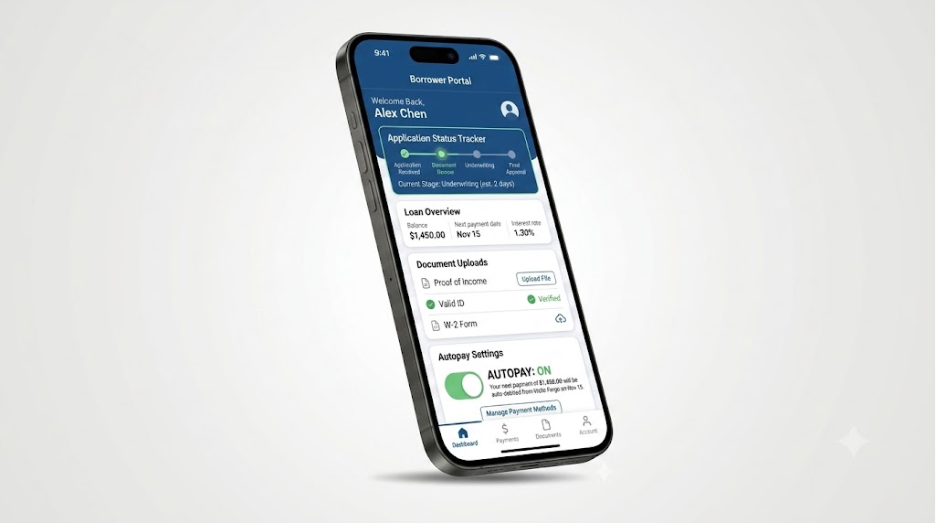
The borrower portal isn't just some box to check off, it's straight up a make or break factor for loan completion. Experience feels clunky or confusing, and applicants bail before they even hit submit.
Here's what actually matters:
- Mobile first design: Most folks are filling this out from their phone, not their desktop.
- Real-time status updates: Keep applicants in the loop without flooding your support line.
- Easy document uploads: Let people snap a photo instead of hunting down a scanner for PDFs.
- Self-service repayment: Give borrowers the power to manage payments, check schedules, and set up autopay on their own.
These aren't flashy features, but they're often what separates a platform borrowers trust from one they abandon.
Step 6: Build Compliance in, don't bolt it on later
Built-in compliance reporting takes the risk down a notch and makes audits way less of a nightmare. Treat it like a core feature, not something you slap on as an afterthought.
These need to be baked in from day one, not bolted on in a panic later:
- End-to-end encryption for data sitting still and data on the move.
- Role-based access control, so folks only see what they're actually cleared for.
- Secure API gateways guarding every single third-party integration.
- Regular penetration testing to sniff out vulnerabilities before they become problems.
- Fraud detection systems run quietly in the background, around the clock.
Compliance Looks Different Depending on Where You Lend
Lending in the US? Your platform's got to handle TILA disclosures, SCRA and MLA protections for military borrowers, and state-specific usury laws automatically, no manual checks, no gaps.
Over in the EU, the AI Act's high-risk rules for credit scoring were originally lined up for August 2026, but a May 2026 political agreement bumped that out to December 2027 for systems like credit checking. Either way, the requirements, documentation, explainability, and human oversight, aren't going anywhere. Building them in now still beats scrambling later.
Running across multiple regions? Build a configurable compliance layer instead of hardcoding rules for just one market. Getting security and compliance right from the jump cuts down your risk, dodges costly rebuilds, and makes scaling a whole lot smoother.
Step 7: Pick Your Integrations Wisely
No lending platform's out here flying solo. You need a clean web of integrations that talk to each other without any friction in the mix.
The non-negotiables:
- KYC and AML providers for identity verification.
- Credit bureaus for pulling scoring data.
- Payment processors for disbursement and repayment.
- E-signature tools for loan agreements.
- CRM or ERP systems if you're running this at any real scale.
API first architecture lets you swap or add integrations without messing with your core platform. You might only need a few services now, but building flexible means you can scale up later without the costly rewrites.
Step 8: Test Like Real Money Is on the Line (Because It Is)
Test every critical piece before you launch. Functional testing checks your loan workflows; performance testing makes sure you can handle growth, compliance testing validates KYC and AML, and security testing finds the holes before attackers do.
Skip any of these and you're looking at security issues, compliance failures, or expensive fixes down the road.
Testing Doesn't Stop at Launch
Launch isn't the finish line, it's the start of ongoing monitoring. Your platform needs uptime monitoring to catch issues early, regular fraud rule updates to keep up with evolving threats, and model drift monitoring to ensure credit scoring stays accurate as borrower behavior and market conditions change.
What Does It Actually Cost to Build This in 2026
A full build with a four to six engineer team usually runs $18,000 to $32,000 a month, though that number swings hard depending on where your team's based and how it's set up. Most MVPs take somewhere between 18 and 28 weeks to land.
Breaking Down the Team Behind That Number
| Role | Typical Monthly Cost Share |
| Backend engineers (2-3) | Largest share, core systems and integrations |
| Frontend engineers (1-2) | Borrower portal, admin dashboards |
| Compliance and QA specialist | Testing, audit readiness, regulatory mapping |
| Project manager | Coordination, timeline, stakeholder communication |
Build Approaches Compared
| Build Approach | Timeline | Control Level |
| Configurable SaaS | Few weeks | Low, capped by vendor roadmap Custom Build |
| (full platform, not MVP) | 18 to 24+ months | Full control |
| Modular Platform Build | Weeks to a year | Pre-built modules, custom logic where it matters |
Configurable SaaS is faster but less flexible, while custom builds offer full control with longer development. Most lenders choose a hybrid approach.
Want an actual number instead of a range? Tell us your lending model and we'll scope it for you.
Don't Forget the Ongoing Cost
Build cost is only part of the investment. Ongoing expenses include cloud infrastructure, third-party API fees, and maintenance for updates, security, and bug fixes. Planning for these costs early helps avoid budget surprises after launch.
Common Mistakes That Sink Lending Platforms
- Treating compliance like a checkbox instead of core architecture.
- Building one giant monolithic codebase instead of modular systems.
- Skipping alternative data scoring and missing huge borrower segments.
- Underestimating integration complexity with KYC, payment, and CRM tools.
- Launching without proper load testing, then crashing the second volume spikes.
- Ignoring database scalability until queries start timing out under real volume.
FAQ
- How long does it take to build a lending platform?
An MVP typically takes 18 to 28 weeks, while enterprise platforms can take a year or more.
- What's the difference between a loan origination system and a loan management system?
A loan origination system handles applications, KYC, and underwriting. A loan management system manages repayments, servicing, and collections after approval.
- Do I need AI credit scoring from day one?
Not necessarily but planning for AI early helps you serve borrowers with limited traditional credit history.
- Is API-first architecture necessary for a small platform?
Yes. It simplifies future integrations and scaling while avoiding expensive rebuilds.
- What's the best database setup?
Use PostgreSQL for structured data, object storage for documents, and a separate system for transaction logs.
Building a lending software platform from scratch is a serious undertaking, but you don't have to figure it all out alone.
IOCOD has hands-on experience building fintech platforms, CRMs, and lending systems that actually hold up under real-world volume.
Talk to our team today and build a lending platform that's ready for 2026.